
Custom Insurance Software Development – A Complete 2026 Guide
The insurance industry is evolving rapidly, and traditional legacy systems can no longer meet modern demands. Custom insurance software development has become a strategic investment for insurers seeking operational efficiency, regulatory compliance, and improved customer experience.
In 2026, insurers must navigate complex technology choices, vendor selection, and cost considerations to ensure success. This guide provides a complete roadmap for custom insurance software development, helping insurers make informed decisions.
Insurance Software Development Services help businesses build custom, secure, and scalable solutions to boost efficiency, compliance, and growth.
Why Insurers Are Investing in Custom Software in 2026

The insurance industry faces pressures that off-the-shelf solutions cannot address. Understanding these drivers helps determine when custom development is truly strategic.
The $234 Billion Protection Gap
Global insured losses in 2023 totaled $100 billion against $357 billion in economic losses, highlighting a massive protection gap. Insurers able to reach underserved markets through digital channels can turn this gap into growth opportunities.
Custom software supports embedded insurance, usage-based policies, and parametric coverage, all of which legacy systems struggle to handle. The embedded insurance market alone is expected to grow 15% in gross written premiums over the next decade.
Solving Disconnected Systems
About 80% of insurers report difficulties with fragmented systems. Custom software unifies policy administration, claims, and customer service, creating operational intelligence and reducing inefficiencies.
Understanding Custom Software ROI
Nucleus Research reports that custom insurance software delivers an average ROI of 122%, with net benefits reaching $1.1 million after costs. Break-even timing depends on scope:
- Focused solutions: 8–10 months
- Enterprise platforms: 14–18 months
ROI sources:
- 40% from operational efficiency (automated underwriting, claims, document generation)
- 35% from compliance cost reduction (fewer violations, lower breach costs)
- 25% from customer retention (online self-service improves satisfaction)
Build vs. Buy – Weighted Decision Framework
Before choosing custom software, insurers should weigh five criteria:
- Customization (30%): How much your workflows differ from standard software
- Integration (25%): Complexity of connecting with legacy systems or proprietary platforms
- Long-term TCO (20%): Total costs over 5 years including maintenance and upgrades
- Time-to-market (15%): Urgency vs. flexibility in deployment
- Competitive differentiation (10%): Technology’s impact on market positioning
Scoring guide:
- 3.5 → Custom software favored
- 2.5–3.5 → Analyze requirements further
- <2.5 → Off-the-shelf solutions may suffice
Types of Custom Insurance Software

Core Policy Administration
Manages the entire lifecycle of a policy. Custom platforms require 40–52+ weeks and $500K–$2M+ due to complex workflows like pricing, endorsements, and renewals.
Claims Management Platforms
Automates claims from first notice to settlement. Focused solutions take 24–36 weeks. Differentiators include AI-powered fraud detection, third-party integration, and self-service portals.
Underwriting Automation
Automates risk assessment and decision-making. Deployment spans 16–28 weeks, particularly useful for high-volume standard risks.
Agent and Broker Management
Supports producer onboarding, commissions, performance tracking, and compliance monitoring. Custom builds require 20–32 weeks, especially with non-standard commission structures.
Customer Portals
Enable self-service management of policies, claims, and payments. Development takes 16–24 weeks, with differentiation coming from real-time integration and personalized recommendations.
Insurance Line-Specific Features
P&C Insurance
- Real-time rating, CAT modeling, high-volume transactions
- CLUE and ISO integration, state-specific reporting, admitted vs. surplus lines
Life Insurance
- Illustration engines, complex product configuration
- Integration with MIB, labs, and underwriting evidence
Health Insurance
- HIPAA-compliant, benefits configuration, provider network management
- Claims adjudication with medical coding, member eligibility verification
Commercial Insurance
- Multi-location accounts, manuscript policies, loss-sensitive rating
- Third-party risk data integration, underwriter collaboration, approval workflows
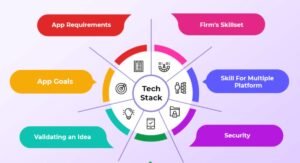
Technology Stack Selection
Backend Options
- Node.js: Event-driven, real-time rating APIs
- Python/Django: Analytics, ML-powered underwriting
- .NET/C#: Enterprise standard, Azure integration
- Java/Spring: Scalable for complex integrations
Frontend and Mobile
- React: Modern portals with reusable components
- Angular: Enterprise governance, TypeScript-first
- Mobile: Kotlin Multiplatform or full native (Swift/Kotlin)
Cloud and Integration
- AWS, Azure, and Google Cloud offer different strengths in compliance, AI/ML services, and cost optimization
- API-first design with RESTful or GraphQL ensures robust integration with payment, CRM, rating bureaus, and document management
Development Timeline (48 Weeks)
- Discovery & Requirements (Weeks 1–6)
- Design & Architecture (Weeks 7–14)
- Development & Integration (Weeks 15–38)
- Testing & QA (Weeks 39–44)
- Deployment & Go-Live (Weeks 45–48)
Cost Analysis
Development costs: $50K–$2M+, depending on complexity
Hidden costs: Integration, data migration, licenses, training, post-launch optimization
5-year TCO: ~$1.34M for mid-complexity systems
Legacy Modernization
- Strangler fig: Gradual replacement
- Parallel running: Operate old and new systems simultaneously
- Big bang: Complete cutover
- Phased migration: Module-by-module replacement
Data migration best practices: profiling, mapping, iterative testing, rollback planning
Security & Compliance
- Multi-factor authentication, encryption, audit logging, penetration testing
- Regulatory frameworks: HIPAA, GDPR, NAIC, CCPA
- Line-specific compliance checklists ensure minimal violations and data breaches
Vendor Selection – Scorecard Methodology
Evaluate vendors on:
- Insurance domain expertise (25%)
- Technical capability (20%)
- Team composition (15%)
- Process maturity (15%)
- Communication (10%)
- Financial stability (10%)
- Cultural fit (5%)
Minimum score: 3.5 to mitigate project risk
Implementation Success Factors

- Clear roles: executive sponsor, product owner, technical lead, SMEs, change management
- Define KPIs: operational efficiency, error rates, cost per transaction, adoption metrics
- Post-launch optimization: performance tuning, process refinement, ongoing training
Real-World Case Studies
- Mid-size P&C Insurer: Implemented AI-powered claims platform, reducing cycle time by 63% and improving ROI to 94% in the first year.
- Life Insurance Company: Migrated legacy system using strangler fig pattern, cutting product launch from 9 months to 6 weeks and saving $400K annually.
- Health Insurance Startup: Built cloud-native, API-first platform, scaling to 28,000 members across 7 states with 71% claims auto-adjudication.
- Investment & Timeline: Projects ranged from $680K to $2.4M and 36–72 weeks depending on complexity and scope.
- Key Outcome: Custom insurance software delivers faster operations, cost savings, compliance, and competitive advantage across different insurance lines.
FAQ
1.What are the 3 DSs of insurance?
The 3 Ds Detection, Documentation, and Defense help insurers manage risk effectively, and integrating them into custom insurance software development improves claims accuracy and operational efficiency.
2.What software does insurance use?
Insurance companies use policy administration, claims management, underwriting, and CRM platforms. Custom insurance software development allows tailored solutions for compliance, automation, and customer experience.
3.What are the big 3 insurance companies?
The big 3 U.S. insurers are State Farm, Berkshire Hathaway (GEICO), and Progressive. Leveraging custom insurance software development enhances operational efficiency and competitive positioning.
4. What is the best CRM for an insurance agency?
Top CRMs like Salesforce, HubSpot, and Zoho integrate with insurance operations. Agencies often use custom insurance software development to tailor CRM workflows for policy, claims, and client management.
5. What is CRM software in insurance?
CRM software in insurance tracks clients, policies, claims, and communication. Custom insurance software development ensures CRMs are tailored to regulatory requirements and specific insurance line needs.
Conclusion
Custom insurance software is a strategic investment, not just an IT project. Success requires structured evaluation from build-vs-buy decisions to vendor scorecards and realistic timelines. By focusing on compliance, integration, and post-launch optimization, insurers can achieve higher ROI, faster product launches, and improved customer satisfaction, transforming technology into a true competitive advantage in today’s complex insurance landscape.